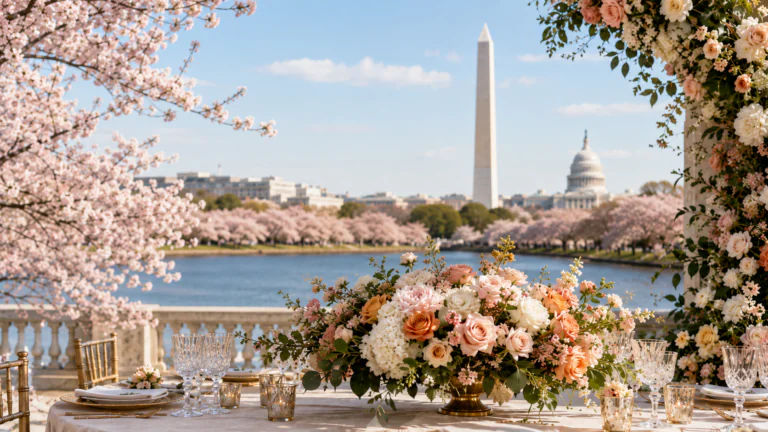
Flowers do more for a Washington, D.C. wedding than almost any other detail. They set the mood the moment guests walk in, frame your ceremony, transform a ballroom or historic mansion, and show up in nearly every photo you’ll keep for the rest of your life. They’re also one of the most misunderstood lines in the budget, especially in a market as competitive as the District.
This guide is built specifically for couples marrying in D.C. and the surrounding DMV region of Maryland and Northern Virginia. We’ll cover what wedding flowers actually cost here, which blooms are in season month by month, how to choose and vet a florist, the styles that suit popular local venues, the trends shaping 2026, and where you can trim spending without making your day look “budget.”
If you’re just starting to think about wedding flowers in Washington, D.C., this is the orientation you need before your first florist consultation.
How Much Do Wedding Flowers Cost in Washington, D.C.?
National averages will mislead you here. Surveys peg the typical U.S. wedding-flower spend somewhere between $1,500 and $3,500, but those figures fold in courthouse ceremonies and backyard weddings across the entire country. The DMV is a high-cost market with expensive venues, premium sourcing, and steep labor and delivery costs, and the numbers reflect that.
For a full wedding in the D.C. area, most couples land somewhere between $5,000 and $12,000 on florals. Weddings with larger guest counts, elaborate ceremony installations, or luxury hotel and estate venues frequently run $15,000 to $20,000 or more. On the lower end, intimate weddings and elopements can come in well under $3,000, but only if you keep the scope tight.
One detail catches many couples off guard: most full-service wedding florists in the area set a minimum spend, commonly $3,000 to $7,500, before they’ll take a wedding at all. That minimum exists because a wedding isn’t a delivery; it’s weeks of design and sourcing plus a full team on the day for setup and breakdown. If the inspiration on your Pinterest board comes from styled shoots rather than real weddings with a dozen tables and a ceremony arch, expect quotes to come in higher than you guessed.
A rough breakdown of common items in this market:
| Item | Typical D.C.-area range |
| Bridal bouquet | $175–$350 |
| Bridesmaid bouquet (each) | $80–$150 |
| Boutonniere (each) | $15–$25 |
| Corsage (each) | $25–$50 |
| Reception centerpiece (each) | $75–$250+ |
| Ceremony arch/installation | $500–$2,500+ |
| Aisle and altar accents | $150–$600+ |
The biggest factors that move your total are guest count (more tables means more centerpieces), season and flower choice (out-of-season and imported blooms cost a premium), design complexity (lush and layered costs more than airy and minimal), and large statement pieces like arches, ceiling installations, or floral-heavy sweetheart tables. As a planning benchmark, florals tend to run about 8% to 12% of an overall wedding budget, but couples who consider flowers a priority routinely spend more.
In-Season Wedding Flowers in Washington, D.C. by Month
Choosing blooms that are naturally in season around your date is the single easiest way to get more beauty for your money. In-season flowers are fresher, more abundant, and dramatically cheaper than imported alternatives, and they make your day feel rooted in the moment. Here’s what works well across the D.C. calendar.
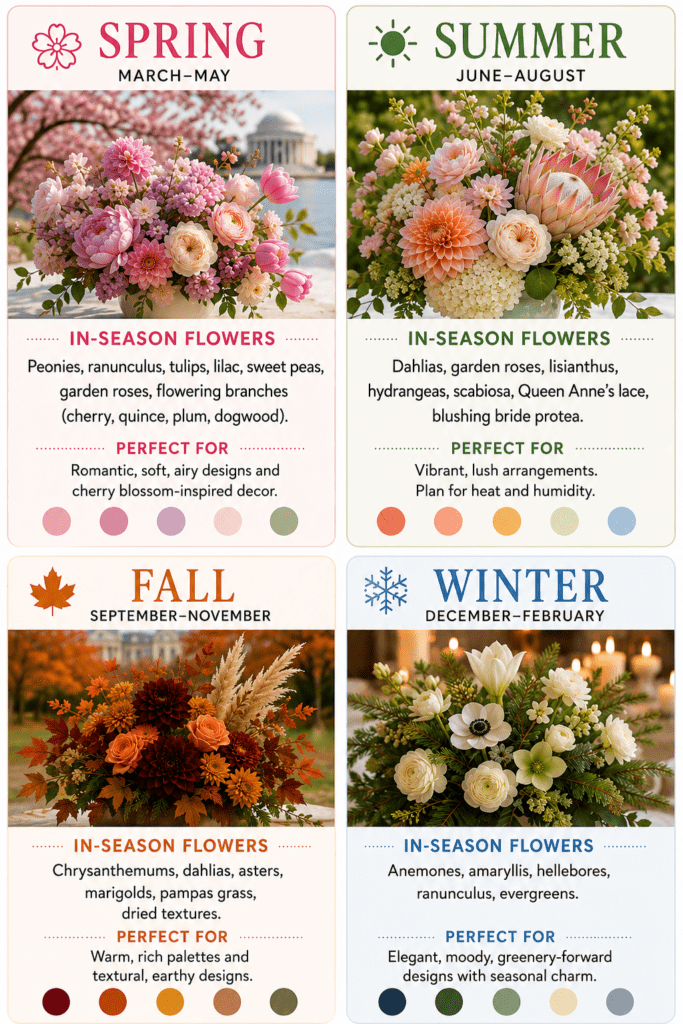
Spring wedding flowers (March–May)
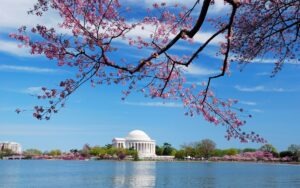
Spring is peak romance in the District. This is the window for peonies, ranunculus, tulips, lilac, sweet peas, and garden roses in soft, lush palettes. It also overlaps with the city’s most famous floral event: cherry blossom season. Peak bloom at the Tidal Basin typically falls in the last week of March into early April (it landed on March 26 in 2026 and around March 28 in 2025), and the National Cherry Blossom Festival generally runs from roughly March 20 through April 12.
A word of realism: you can’t cut the Tidal Basin’s cherry trees, and true cherry blossom is fragile and hard to source as a cut flower. To echo that blossom look, skilled local florists use flowering branches such as cherry, quince, plum, or dogwood, which bring the same airy, blooming-branch silhouette to arches and tall arrangements. Keep in mind that spring weekends, particularly during the festival, are among the most in-demand and expensive dates in the entire region.
Summer wedding flowers (June–August)
Summer offers the widest variety of the year. Look to dahlias, garden roses, lisianthus, hydrangeas, scabiosa, Queen Anne’s lace, and blushing bride protea for arrangements that range from garden-romantic to textural and modern. Dahlias in particular peak from midsummer into early fall and give you enormous color and shape for the cost.
The trade-off is heat and humidity. D.C. summers are brutal on delicate blooms, so for outdoor ceremonies, lean on hardier varieties, plan for shade and water, and talk with your florist about timing the install as close to the ceremony as possible. Some couples reserve the most heat-sensitive flowers for indoor, air-conditioned spaces.
Fall wedding flowers (September–November)
Fall is the most popular wedding season in the DMV, and the palette leans warm and textural. In-season stars include chrysanthemums, dahlias, asters, and marigolds, often paired with pampas grass and dried textures for that earthy, layered look. Deep jewel tones, rust, burgundy, and copper all feel right against the region’s autumn foliage and historic architecture.
Because fall weekends book up first, this is the season where booking your florist early matters most. Dried and preserved elements are also a smart fall play: they hold up beautifully, photograph well, and let you build volume without paying for as many perishable stems.
Winter wedding flowers (December–February)
Winter weddings get an underrated floral toolkit. Anemones, amaryllis, hellebores, and ranunculus provide structure and elegance, while evergreens add lushness, fragrance, and a seasonal sense of place for a fraction of what flowers alone would cost. Moody, monochromatic palettes and candlelight-heavy tablescapes look spectacular in winter.
Winter is also the most negotiable season in the DMV. Demand is lower outside the holidays, so you may find more florist availability and, occasionally, more flexible pricing. Greenery-forward designs are especially cost-effective this time of year.
Choosing a Wedding Florist in Washington, D.C.
The District, Maryland, and Northern Virginia are home to a deep bench of floral talent, from luxury studios recognized year after year by Washingtonian Weddings to boutique, budget-conscious designers and farm-based growers. The vetted directories on Washingtonian, The Knot, WeddingWire, and Zola are good starting points, but the right florist for you depends less on rankings and more on fit, scope, and communication.
Full-service florist vs. à la carte vs. DIY
A full-service florist handles everything: design, sourcing, delivery, on-site setup, and post-event breakdown, plus large installations. It’s the most hands-off and the most expensive option, and it’s the standard for larger DMV weddings.
An à la carte florist provides specific pieces (bouquets, boutonnieres, a handful of centerpieces) for pickup or simple drop-off, which suits smaller, lower-lift weddings.
DIY can save real money but is far more work than it looks: you’re sourcing wholesale, processing flowers, building arrangements the day before, and managing transport and storage, all during one of the busiest weeks of your life. DIY tends to make sense only for very small, simple celebrations.
Questions to ask before booking your D.C. wedding florist
Bring a focused list to your consultation. Strong questions include: Are you available on my date, and how many weddings do you take per weekend? What’s your minimum spend? Have you worked at my venue, and are there any restrictions there (open flame, hanging installations, breakdown timing)? Can ceremony pieces be repurposed at the reception? How do you handle substitutions if a flower isn’t available or the quality is poor? What’s included in delivery, setup, and breakdown, and what does the timeline look like on the day? When are payments due, and what’s your cancellation policy?
How far in advance to book
In this market, nine to twelve months out is the standard, and earlier is better for peak-season weekends (roughly April through October) and for the most sought-after designers. Many popular florists cap how many weddings they accept per weekend, so the calendar fills quickly. Lock in your venue and date first, then make your florist one of your earliest vendor bookings.
Red flags and green flags when reviewing proposals
Green flags: an itemized proposal that lists quantities and pieces clearly; a designer who asks about your budget and venue early and steers you honestly; willingness to suggest in-season swaps; a clear setup-and-breakdown plan; real wedding photos (not just styled shoots) and consistent reviews.
Red flags: vague lump-sum pricing with no breakdown; promises of out-of-season blooms with no caveat about cost or availability; pressure to sign immediately; no contract or a contract that’s silent on substitutions and timing; portfolios that don’t match the style you’re after. A great florist will tell you when your vision and your budget don’t align, and offer a path that does.
Best Wedding Flower Styles for Popular D.C. Venues
The District’s venues span Gilded Age mansions, marble museums, hotel ballrooms, urban wineries, and country estates, and the smartest floral choices play to the room you’ve chosen rather than fighting it.
Historic mansions and Beaux-Arts spaces (think Anderson House, Meridian House, Perry Belmont House, or The Whittemore House) already carry ornate architecture, gilded detail, and grand staircases. Lush, garden-style arrangements in classic palettes complement that elegance, and you generally need less to fill these spaces because the architecture does so much of the work.
Luxury hotel ballrooms (the Hay-Adams, St. Regis, Four Seasons, Fairmont, Mayflower, Omni Shoreham) reward height and impact. Tall centerpieces, statement entryway arrangements, and dramatic focal pieces read well across a large room and high ceilings, helping the space feel intentional rather than cavernous.
Modern museums and galleries (Long View Gallery, the National Museum of Women in the Arts, the Carnegie Institution for Science) pair beautifully with sculptural, architectural, and minimal designs. Negative space, clean lines, and a restrained palette let the art and the space breathe.
Urban waterfront and winery spaces (District Winery, the Salamander at The Wharf) suit airy, contemporary, and slightly industrial-leaning florals that echo the water and the modern setting.
Garden estates and country venues (Hillwood Estate, Meadowlark Botanical Gardens, Woodend Sanctuary, and the vineyards and estates of Loudoun County) call for loose, organic, garden-grown looks, wildflower textures, and seasonal blooms that feel at home in the landscape.
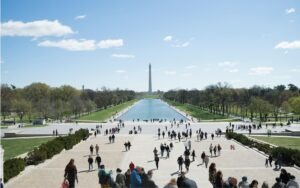
National Mall and monument ceremonies require portability and resilience. With permit-based outdoor sites, the wind, sun, and limited setup time mean hand-held bouquets and a few hardy, transportable pieces beat fragile installations.
Wedding Flower Trends in D.C. for 2026
Floral design in 2026 has shifted away from post-pandemic maximalism toward what designers are calling intentional or “smart luxury”: fewer, more deliberate statement moments rather than flowers everywhere. Here’s what’s shaping local weddings.
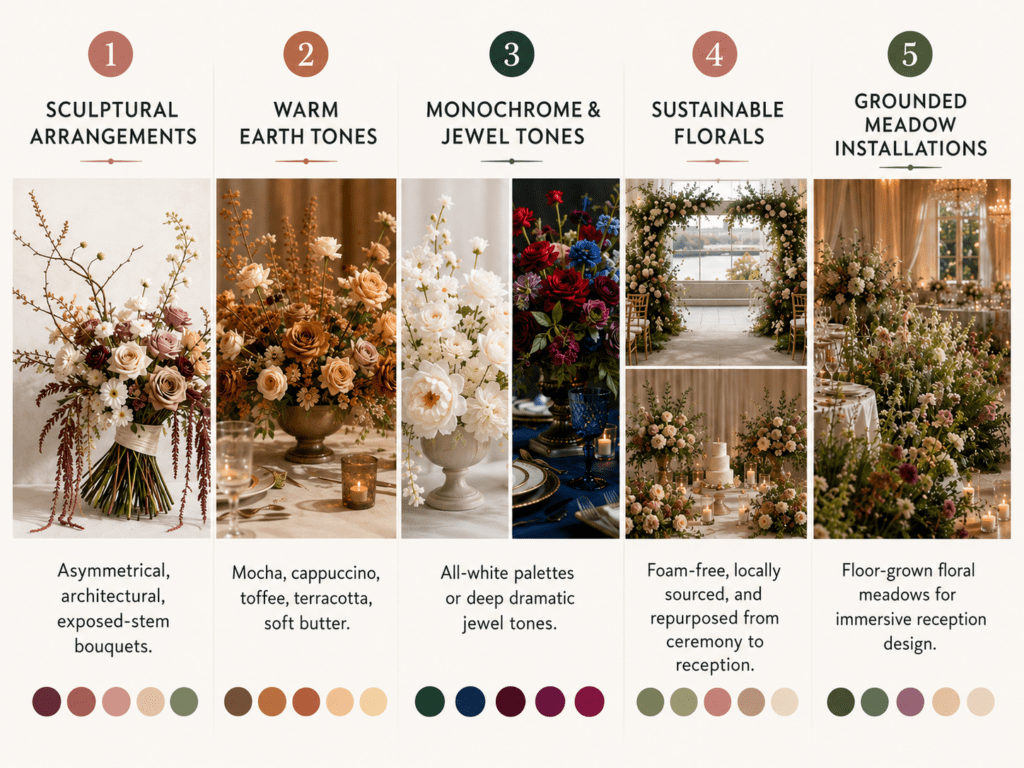
Sculptural, architectural arrangements are the headline trend, with asymmetry, movement, and intentional negative space replacing tight, perfectly round designs. Amaranthus has emerged as the breakout bloom of the year, prized for its draping, sculptural stems, with floral pros reporting enormous year-over-year growth in requests. Long-stemmed and exposed-stem bouquets share the same architectural mood.
On color, Pantone’s Mocha Mousse has pushed warm earth tones, cappuccino, toffee, and terracotta to the front, alongside two perennials: clean all-white monochromatic palettes and deep jewel tones (emerald, sapphire, berry) for fall and winter drama. Butter and pale lemon are the fresh spring options. Monofloral and monochromatic designs, built around a single flower or a single shade layered for depth, continue to grow.
Sustainability has moved from nice-to-have to genuine design driver: foam-free mechanics, locally and seasonally sourced blooms, and a now-standard practice of repurposing ceremony florals at the reception (the arch becomes a backdrop for the sweetheart table; aisle arrangements move to the cake display). You’ll also see grounded “meadow” installations that rise from the floor between tables in place of traditional tabletop centerpieces. As a counterpoint, baby’s breath as a primary flower and dense, rustic looks in formal city settings are fading.
How to Save on Wedding Flowers Without Sacrificing Style
You can cut floral spending substantially without anyone being able to tell. The most effective moves:
Choose in-season, locally grown blooms and let your florist substitute freely; this alone can reduce costs by a meaningful margin. Repurpose ceremony flowers at the reception so you’re paying once for pieces that work twice. Lean on greenery, branches, candles, and texture to build volume, since these create lush, full looks for far less than premium focal flowers.
Concentrate your budget on a few high-impact statement pieces (the entrance, the head table, one ceremony moment) rather than spreading flowers thinly everywhere. Trim the wedding-party florals: smaller or fewer bridesmaid bouquets, single-bloom boutonnieres, and bud-vase or greenery-led centerpieces all add up. Consider an off-peak date (winter, or a Friday or Sunday) when both venues and florists tend to have more flexibility. And be honest about your real budget at the consultation, so your florist can design to it from the start instead of paring back a dream proposal piece by piece. Finally, ask whether rentals (vessels, candle holders, arch structures) are available, since reusable hardware is cheaper than buying.
Wedding Centerpieces from Ode à la Rose in Washington, D.C.
If you love the idea of designer-quality table flowers without taking on a full-service florist’s minimum, Ode à la Rose is a smart option for D.C. couples. Known for French-inspired arrangements and signature packaging, Ode à la Rose delivers fresh flowers across Washington, D.C. (along with New York City, Chicago, Los Angeles, Austin, and Miami), so beautiful centerpieces can be brought straight to your venue.
The centerpiece collections are created by Ode à la Rose’s in-house ateliers and designed to shop online: choose your style, select your delivery date, and order the number of arrangements your tables need. The range spans lush, low-footed-bowl designs that sit gracefully between place settings to tall, dramatic centerpieces that bring height to a reception, in palettes from timeless white-and-green to seasonal, color-forward blooms.
It’s an especially good fit for intimate weddings, rehearsal dinners, bridal showers, and receptions where centerpieces are the floral focus and you’d rather keep ordering simple and predictable. Because event florals and centerpieces can have specific delivery windows, place your order well ahead of your date so everything arrives fresh and right on time.
Ready to set your tables? Browse Ode à la Rose’s centerpiece collections and choose the blooms for your Washington, D.C. celebration.
Frequently Asked Questions About Wedding Flowers in Washington, D.C.
What is the average cost of wedding flowers in Washington, D.C.? Most Washington, D.C. couples spend between $5,000 and $12,000 on wedding flowers, well above the national average. Larger guest counts, elaborate ceremony installations, and luxury venues can push budgets to $15,000–$20,000 or more. Many full-service D.C. florists also set minimums of $3,000 to $7,500 per wedding.
When should I book my D.C. wedding florist? Book your D.C. wedding florist nine to twelve months before your date, especially for peak-season weekends from April through October. Popular florists take a limited number of weddings each weekend and fill up fast, so reach out shortly after you secure your venue to protect your first choice.
Do D.C. wedding florists have a minimum order? Yes. Most full-service wedding florists in the D.C. area require a minimum spend, typically between $3,000 and $7,500, to cover the design time, sourcing, setup, and breakdown required by a wedding. Smaller studios and à la carte florists may have lower minimums, making them better suited to intimate weddings and elopements.
Can I have peonies for a fall D.C. wedding? Local peonies bloom in late spring, so fall peonies must be imported, cost significantly more, and have limited availability. A skilled florist can sometimes source them at a premium, but garden roses, dahlias, and ranunculus deliver a similar lush, romantic look for far less in autumn.
Are wedding flowers cheaper in Maryland or Virginia than in D.C.? Slightly, sometimes. Florists based in the Maryland or Northern Virginia suburbs may carry lower minimums than downtown D.C. studios, but delivery fees for city venues can offset the difference. The bigger savings levers are your flower choices, guest count, and design complexity, not which side of the river your florist sits on.
What flowers are in season in D.C. during cherry blossom season? Cherry blossom season (late March into early April) overlaps with D.C.’s spring blooms: tulips, ranunculus, sweet peas, lilac, anemones, and early garden roses. True peonies arrive slightly later in spring. For that blossom look, florists use flowering branches like cherry, quince, or plum rather than the Tidal Basin trees.
Bringing Your D.C. Wedding Florals to Life
Wedding flowers in Washington, D.C. are an investment, but they’re also one of the few details that touch every part of your day, from the bouquet you carry down the aisle to the tablescape your guests sit around all night. The couples who feel best about their floral spend are the ones who plan early, choose in-season blooms, design for the venue they actually booked, and work with a florist who’s honest about what their budget can do.
Start by setting a realistic range using the figures above, then book your venue and date, and start your floral planning nine to twelve months ahead. When you find arrangements whose style matches your vision and a budget that works for you, you’ll know.
Ready to bring it all together? Explore Ode à la Rose’s centerpiece collections and have fresh, atelier-designed arrangements delivered straight to your Washington, D.C. celebration.