
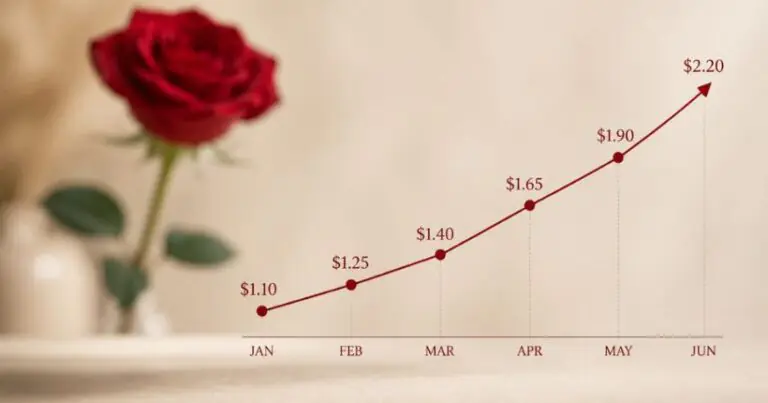
A six-year analysis of entry-level bouquet prices across four major US flower delivery platforms, benchmarked against Freedom rose wholesale costs and contextualized with logistics, labor, and structural cost data. Entry-level bouquets vary by platform and year in stem count, flower variety, and arrangement composition; prices reflect the lowest listed option at the time of recording.
Between 2020 and 2026, the average wholesale cost of 1,000 Freedom roses, the industry’s benchmark red rose, rose by nearly 85%. Over that same period, the average entry-level bouquet price across four major online flower delivery platforms rose by 40%. This report tracks both numbers side by side, without drawing conclusions about what any individual platform’s pricing decisions reflect.
An important limitation applies throughout: entry-level bouquets are not a standardized product. The cheapest available bouquet on any given platform in any given year may differ in stem count, flower variety, arrangement size, and overall composition, both from other platforms and from the same platform in prior years. Price changes in the retail data, therefore, reflect a combination of market pricing and product-level changes that cannot always be separated with the data available. Readers should treat the retail figures as a record of what the lowest-priced option cost at the time of recording, not as a direct like-for-like comparison across all years and platforms.
The report also examines how the drivers of price pressure have shifted over the six-year period. Earlier in the dataset, wholesale grower costs were the dominant variable. More recently, downstream cost components such as logistics, labor, insurance, fuel surcharges, and other structural operating costs have become the more significant contributors to sustained price pressure across the value chain.
| +40% Avg. retail entry-bouquet price increase 2020–2026 | +85% Avg. wholesale Freedom rose cost increase 2020–2026 | 45 pts Gap between wholesale and retail inflation |
Methodology
| DATA COLLECTION – Retail: Entry-level bouquet prices recorded each May from 2020 to 2026 across four major US online flower delivery platforms – Wholesale: Cost per 1,000 Freedom roses recorded each May from 2019 to 2026 from two US wholesale suppliers (anonymized as Supplier A and Supplier B) – All retail prices are pre-delivery fee, as listed on each platform’s public website – Freedom roses are used as the wholesale benchmark, a standard variety used across the industry – Platform and supplier names are withheld; platforms are categorized by business model type – Index calculations use 2020 as the base year (= 100) for comparison |
Retail Price Trends (2020–2026)
The four platforms in this dataset represent distinct segments of the online flower delivery market: a legacy marketplace platform, a premium delivery brand, a bouquet subscription brand, and a direct-from-farm brand. Entry-level bouquets across these platforms are not directly comparable, as they differ in stem count, flower types, and arrangement style, and those product specifications have changed within individual platforms over the period covered. The prices below reflect the lowest publicly listed bouquet on each platform each May, before delivery or other fees.
TABLE 1. ENTRY-LEVEL BOUQUET PRICES BY PLATFORM (USD, PRE-DELIVERY FEE)
| Year | Platform A | Platform B | Platform C | Platform D | 4-Platform Avg |
|---|---|---|---|---|---|
| 2020 | $20 | $39 | $29 | $59 | $36.75 |
| 2021 | $32 | $36 | $34 | $59 | $40.25 |
| 2022 | $20 | $40 | $35 | $59 | $38.50 |
| 2023 | $30 | $40 | $39 | $59 | $42.00 |
| 2024 | $42 | $44 | $39 | $59 | $46.00 |
| 2025 | $62 | $49 | $39 | $55 | $51.25 |
| 2026 | $60 | $49 | $44 | $53 | $51.50 |
Platform-by-Platform: Who Raised Prices Most
Platform A recorded the largest price movement in the dataset, going from $20 in 2020 to $60 in 2026, a 200% increase. Platform C moved from $29 to $44, a 51.7% increase. Platform B increased from $39 to $49, a 25.6% increase. Platform D is the only platform to end the period below its 2020 price, declining 10.2% from $59 to $53 after holding at $59 for five consecutive years before reducing in 2025. As noted, these movements reflect both pricing changes and any changes to the bouquet product itself over the period.
TABLE 2. CUMULATIVE PRICE CHANGE BY PLATFORM (2020–2026)
| Platform | 2020 Price | 2026 Price | Change ($) | Change (%) |
|---|---|---|---|---|
| Platform A | $20 | $60 | +$40 | +200% |
| Platform C | $29 | $44 | +$15 | +51.7% |
| Platform B | $39 | $49 | +$10 | +25.6% |
| Platform D | $59 | $53 | −$6 | −10.2% |
| 4-Platform Average | $36.75 | $51.50 | +$14.75 | +40.1% |
Wholesale Cost Trends (2019–2026)
Freedom roses are among the most widely traded varieties in the wholesale flower market and serve as a reliable proxy for broader rose pricing. The wholesale data in this report, drawn from two US suppliers, covers 2019 through 2026, providing a baseline year prior to COVID that contextualizes the disruption that followed.
The wholesale data also illustrates a key feature of recent grower pricing: it has been volatile rather than steadily rising. After the 2023 peak, wholesale costs corrected sharply in 2024 before rising again. Across the most recent four years of data (2023–2026), the average wholesale cost has moved within a $370 range without establishing a clear upward trajectory.
TABLE 3. WHOLESALE COST PER 1,000 FREEDOM ROSES (USD)
| Year | Supplier A | Supplier B | Average | YoY Change (Avg) |
|---|---|---|---|---|
| 2019 | $580 | $980 | $780 | n/a |
| 2020 | $620 | $980 | $800 | +2.6% |
| 2021 | $741 | $1,449 | $1,095 | +36.9% |
| 2022 | $868 | $1,499 | $1,184 | +8.1% |
| 2023 | $1,687 | $1,299 | $1,493 | +26.1% |
| 2024 | $969 | $1,240 | $1,105 | −26.0% |
| 2025 | $1,008 | $1,280 | $1,144 | +3.5% |
| 2026 | $1,054 | $1,900 | $1,477 | +29.1% |
Two years stand out in the wholesale data. The first is 2021, when the average cost jumped nearly 37% in a single year, from $800 to $1,095 per 1,000 stems. This coincides with the period of documented disruption to global flower supply chains during and following COVID-19, when grower production levels and consumer demand patterns shifted significantly.
| NOTABLE DATA POINT In 2023, Supplier A recorded a wholesale price of $1,687 per 1,000 Freedom roses, a 94% increase from its 2022 price of $868, and the highest single data point in this dataset. Supplier B recorded $1,299 that same year, down from $1,499 in 2022. The 2023 spread between the two suppliers was $388 per 1,000 stems, the largest recorded divergence in the dataset prior to 2026. |
Average wholesale costs fell 26% in 2024 before rising again in 2025 and 2026. By 2026, Supplier B reached its highest recorded price of $1,900, bringing the average to $1,477. This is the second-highest annual average in the dataset, below only the 2023 peak.
The Spread: Retail vs. Wholesale Indexed (2020 = 100)
Indexing both retail and wholesale to 2020 shows the degree to which the two series have moved at different rates and in different patterns. The wholesale index has experienced larger swings in both directions; the retail index has moved more gradually across the period.
The widest point of divergence occurs in 2023: the wholesale index reached 186.6 while the retail index stood at 114.3, a gap of 72.3 index points. In 2025, the two series came closest together, with wholesale at 143.0 and retail at 139.5, a gap of 3.5 index points. By 2026, the gap widened again to 44.5 index points, with wholesale at 184.6 and retail at 140.1.
TABLE 4. RETAIL VS. WHOLESALE INDEX (2020 = 100)
| Year | Retail Index (2020=100) | Wholesale Index (2020=100) | Gap (index points) |
|---|---|---|---|
| 2020 | 100.0 | 100.0 | 0.0 |
| 2021 | 109.5 | 136.9 | +27.4 |
| 2022 | 104.8 | 147.9 | +43.1 |
| 2023 | 114.3 | 186.6 | +72.3 |
| 2024 | 125.2 | 138.1 | +12.9 |
| 2025 | 139.5 | 143.0 | +3.5 |
| 2026 | 140.1 | 184.6 | +44.5 |
What’s Driving the Numbers
The drivers of price pressure in the online flower delivery market have shifted across the six years covered by this dataset. The earlier portion of the period (2020–2022) was dominated by supply-side shocks at the grower level. The more recent portion (2023–2026) reflects a more mixed picture, in which wholesale costs have been volatile rather than continuously rising, while costs further down the value chain, such as logistics, labor, insurance, fuel, and structural operating costs, have continued to climb. The sections below treat these two phases separately.
Phase 1: Supply-Side Shocks (2020–2022)
The 2020 baseline in this dataset coincides with the onset of COVID-19, a period during which grower production levels were reduced in many origin countries as hospitality and event demand declined. Consumer demand for direct-to-consumer delivery platforms increased over the same period. Partially due to pandemic caused supply chain disruption & increased transportation costs, the wholesale average increased 36.9% in 2021. Wholesale costs continued to rise through 2022 before reaching their recorded peak in 2023.
During this phase, the wholesale price was the most visible variable in the cost structure of online flower delivery, and the dominant driver of cost pressure on retailers.
Phase 2: Wholesale Volatility and Rising Downstream Costs (2023–2026)
After the 2023 peak, wholesale rose costs did not continue rising in a straight line. Average wholesale costs fell 26% in 2024, rose modestly in 2025, and rebounded in 2026. The 2026 average ($1,477) remains below the 2023 peak ($1,493). Over the most recent 4 years of data, the wholesale price has moved within a band rather than on a sustained upward trajectory.
Over the same recent period, several downstream cost components (costs that occur after roses leave the grower and before a bouquet reaches the consumer) have continued to rise. The table below summarizes published data on these components.
TABLE 5. DOWNSTREAM COST COMPONENTS, RECENT REPORTED CHANGES
| Cost component | Reported change | Period |
|---|---|---|
| Truck transportation insurance | +12.5% in 2023; +3% in 2024 (per-mile basis) | 2023–2024 |
| Commercial transportation insurance (sector-wide) | +7.26% (largest sector increase) | 2023 |
| Commercial auto insurance premiums | +5.8% YoY | Q1 2025 |
| Physical damage coverage (transportation) | +20% to +25% | Reported 2024–2025 |
| Truck/trailer payments per mile | +8.3% (cumulative +52.3% since 2019) | 2023–2024 |
| Producer Price Index, transportation & warehousing services | +3.4% YoY | Year ended Sept 2025 |
| Private-industry wages & salaries (BLS ECI) | +3.5% YoY | June 2024 – June 2025 |
| Air freight Latin America → US | Elevated rates throughout 2024–2025 | 2024–2025 |
Sources: BLS Producer Price Index (transportation and warehousing services), BLS Employment Cost Index, American Transportation Research Institute (ATRI), MarketScout commercial insurance barometer, Risk Strategies transportation insurance reports, C.H. Robinson air freight market updates.
Import Dependency and Air Freight
The United States imports approximately 80% of its cut flowers, with Colombia and Ecuador accounting for the vast majority of that supply. Freedom roses are sourced predominantly from high-altitude farms in these countries. Between 2020 and 2024, US imports of cut flowers from Colombia nearly doubled in value, according to USDA trade data, reflecting both volume and per-unit cost changes over the period.
Because the supply chain depends almost entirely on air freight from Latin America, air cargo costs are an important component of the cost of cut flowers. Industry market updates have reported that air freight spot rates from Latin America to the United States remained elevated throughout 2024 and into 2025, driven by strong demand, capacity volatility, and operational disruptions in major regional hubs. According to IATA data, global air cargo unit revenue rose 7.0% year-over-year in early 2025, continuing an upward trajectory that began in mid-2024. Latin America and the Caribbean recorded the strongest regional cargo demand growth in early 2025 at 10.0% year-over-year.
Labor and Wage Costs
Labor cost increases have been broad-based across the relevant industries. According to the Bureau of Labor Statistics Employment Cost Index, compensation costs for private-industry workers rose 3.5% in the year ending June 2025, with wages and salaries rising 3.5% over the same period. The prior 12 months (June 2023 to June 2024) recorded a 3.9% increase in compensation costs and a 4.1% increase in wages and salaries.
In the transportation and warehousing sector, which directly affects the fulfillment side of online flower delivery, BLS Occupational Employment and Wage Statistics show truck transportation wages rising above $30 per hour in 2024–2025. The BLS Producer Price Index for transportation and warehousing services rose 3.4% year-over-year through September 2025, following a 2.1% increase across calendar year 2024.
Insurance and Liability Costs
Commercial transportation insurance has been one of the more significant sources of downstream cost increases in recent years. According to the American Transportation Research Institute, the trucking industry’s per-mile cost of insurance rose 12.5% in 2023 and a further 3% in 2024, with premiums reaching a record 10.2 cents per mile. Carriers reported a further 5.8% year-over-year increase in commercial auto insurance premiums in Q1 2025, and ATRI data indicate that 2025 increases were expected to outpace 2024.
Insurance is particularly relevant to flower delivery operations because it covers vehicle fleets, drivers, cargo in transit, and the cold-storage facilities that hold flowers between import and delivery. Once written into commercial contracts, increased premiums tend to remain in cost structures rather than reverse, even when the underlying loss conditions improve.
Fuel Surcharges
Fuel surcharges in the freight and logistics industry are typically calculated using formulas tied to the U.S. Department of Energy’s national diesel and jet fuel indexes. Most major carriers, including FedEx, UPS, and large LTL carriers, publish fuel surcharge tables that adjust weekly based on those indexes. Because surcharge formulas use stepped thresholds rather than continuous adjustment, surcharge rates can remain elevated even when fuel prices ease modestly, and tend to adjust upward more quickly than they reverse. The result is that fuel-related costs tend to act as a floor under freight pricing rather than as a fully variable input.
Tariffs and Trade Policy
Cut flower imports from Latin America have been affected by changes in US trade policy during the most recent portion of the dataset. The introduction of new US tariffs in April 2025 affected the global ornamental flower trade, particularly Colombia, which exports approximately 80% of its $2.4 billion in floral products to the United States. The tariff environment has also contributed to broader logistics market volatility, as air cargo industry analyses have cited 2025 US tariff actions as a factor in trade flow shifts and capacity reallocations across major lanes.
Supplier Divergence in 2026
In 2026, Supplier A recorded $1,054 per 1,000 stems, and Supplier B recorded $1,900, a spread of $846 and the largest recorded in this dataset. The two suppliers were within $100 of each other in 2019 and 2020 but the gap has widened progressively since 2021. The dataset does not include information on the sourcing origin, rose grade, or contract terms that may account for this divergence.
Key Data Points
KEY DATA POINTS
- Wholesale costs rose 84.6% on average across both suppliers between 2020 and 2026; retail entry-level prices rose 40.1% on average across all four platforms over the same period.
- Platform price movement ranged from −10.2% to +200% over the 2020–2026 period. Entry-level bouquets are not standardized products and may have changed in composition, stem count, or flower variety across platforms over the years.
- The widest wholesale-retail index gap occurred in 2023, at 72.3 index points (wholesale: 186.6, retail: 114.3). The narrowest gap was in 2025, at 3.5 index points.
- Wholesale costs have been volatile rather than continuously rising. Year-over-year changes ranged from −26.0% (2024) to +36.9% (2021). The most recent rebound to $1,477 (2026) follows a correction in 2024.
- Downstream costs have continued rising even when wholesale prices eased. Transportation and warehousing producer prices rose 3.4% YoY through September 2025, and commercial transportation insurance rose 12.5% in 2023, followed by further increases through 2025.
- The two wholesale suppliers diverged to their widest recorded spread in 2026, at $846 per 1,000 stems, after being within $100 of each other in 2019 and 2020.
Bottom Line
Between 2020 and 2026, wholesale costs for Freedom roses averaged an 84.6% increase across the two suppliers in this dataset, while average entry-level retail bouquet prices across the four tracked platforms increased by 40.1%. The two series moved at different rates and with different volatility profiles over the period, with the largest recorded divergence occurring in 2023 and a brief convergence in 2025.
The drivers of price pressure shifted across the period. In the earlier years (2020–2022), grower-side supply shocks were the dominant variable. In the more recent period (2023–2026), wholesale rose costs have been volatile rather than continuously increasing, while downstream costs such as air freight, labor, transportation insurance, fuel surcharges, and tariffs have continued to rise on aggregate, even during years when wholesale rose costs eased. Some of these downstream costs (particularly insurance premiums and fuel surcharge formulas) tend to create a floor under pricing because they adjust upward faster than they reverse.
The retail figures in this dataset record price changes at the entry-level bouquet tier. Because the composition of entry-level bouquets, including stem count, flower variety, and arrangement type, is not standardized and may change from year to year within a platform, the retail price data reflects both market pricing conditions and any product-level changes that occurred over the period. Those two factors cannot be separated with the data available.
The wholesale data covers a single flower variety (Freedom roses) across two anonymized US suppliers and represents per-1,000-stem pricing recorded each May from 2019 to 2026. Both the retail and wholesale datasets have the limitations described in the methodology section and should be interpreted accordingly.
Retail prices reflect the lowest publicly listed bouquet on each platform in May of each year, before delivery fees or add-ons. Wholesale prices reflect per-1,000-stem Freedom rose pricing from two US wholesale suppliers. Entry-level bouquets are not standardized products and may vary in stem count, flower type, and composition, both across platforms and within the same platform across different years. Platform and supplier names are withheld. External data sources cited include the US Bureau of Labor Statistics (Employment Cost Index, Producer Price Index), USDA trade and floriculture data, the American Transportation Research Institute, the MarketScout commercial insurance barometer, Risk Strategies transportation insurance reports, IATA Air Cargo Market Analysis, and C.H. Robinson Freight Market Updates.