
Ever wonder if you’re the only one scrambling to order flowers at the last minute? Or maybe you’re the person who has Valentine’s Day handled by early February, wondering why everyone else is panicking?
Turns out, where you live says a lot about how you approach Valentine’s Day. We analyzed over 9,000 Valentine’s Day orders across more than 1,000 U.S. cities, combined with Google search data and national search trends, and the differences are striking. Seattle residents order flowers an average of 6.3 days in advance. In Brooklyn? The average is 3.2 days, with one in five orders arriving same-day.
The patterns we found may even reveal something deeper than just delivery preferences – how regional culture, work styles, and city infrastructure shape the way we express romance.

How We Got the Data
To understand Valentine’s Day ordering behavior, we looked at three different data sources:
Our 2025 Valentine’s Day Orders: We analyzed a very large representative sample of orders delivered to over 1,000 US cities during Valentine’s Day week 2025. Many of our orders are clustered in the cities where we have a local atelier & offer same-day delivery (New York City, Chicago, Los Angeles, Austin, Miami, & Washington, D.C.), but we had significant enough order volume across hundreds of other cities to draw some interesting insights across the US.
By tracking when people placed their order in comparison to their delivery date, we could calculate averages & bucket orders by how far in advance they were placed (e.g. same-day, 1-2 days out, 3-5 days out, 6-12 days out, or 13+ days out).
Google Trends: We tracked search patterns for Valentine’s Day-related terms like “valentines day flowers” and “flower delivery” from January 1 through February 28, 2025, across seven major states: California, Florida, Illinois, New York, Ohio, Pennsylvania, Texas, and Washington, D.C.. Google Trends shows relative search interest on a 0-100 scale, where 100 represents peak interest during that period.
Search Volume Data: We looked at how many people searched for Valentine’s Day flower terms like “valentines day flower delivery” and general “flower delivery” each month from December 2024 through February 2025. This helped us understand when people start thinking about Valentine’s Day versus when they actually take action.
What We Found
Four major patterns emerged from the data:
- The coasts are different. West Coast and Southern cities tend to plan significantly further ahead (5-6+ days) compared to East Coast urban centers (2-4 days).
- Procrastination is everywhere. Between 35-50% of orders in major cities are placed in the final 48 hours before their delivery date. In some cities, up to 20% of people place orders for same-day delivery. Valentine’s Day is February 14th every single year yet it always seems to sneak up on people!
- People start their research early, but order late. Google searches for “valentines day flower delivery” start building in January, but actual orders cluster heavily in the 3 days leading into Valentine’s Day. There’s a big gap between thinking about it and doing it.
- Valentine’s Day sends last-minute flower searches surging. Across all seven states we tracked, “flower delivery” searches peaked at their maximum on February 14th itself. It doesn’t matter where you live – Valentine’s Day creates last-minute panic everywhere.
Cities That Order Valentine’s Flowers the Earliest
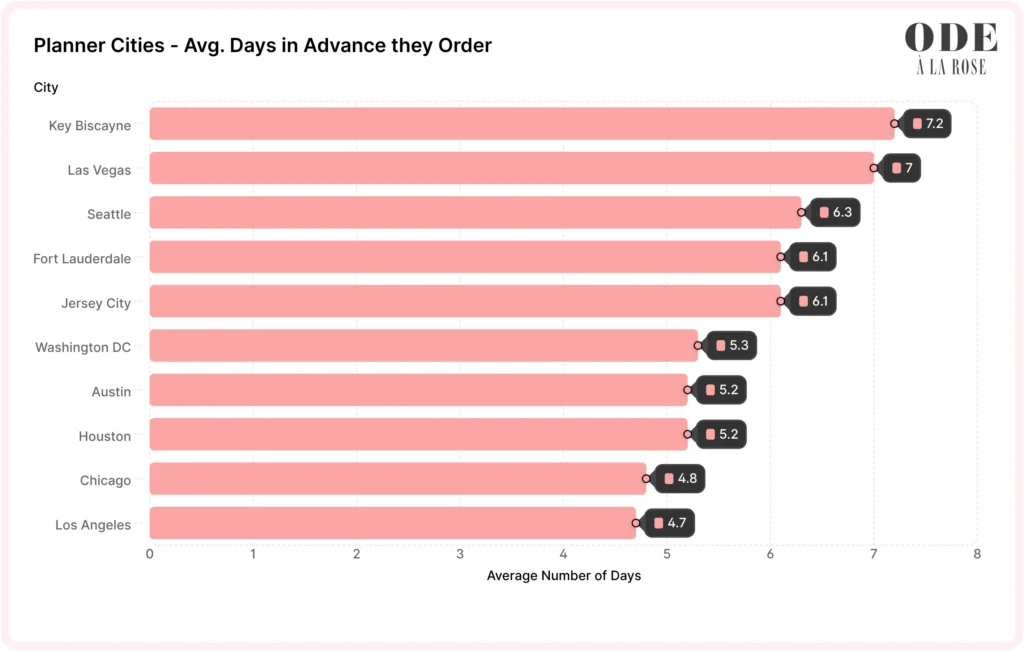
When we looked at which cities plan furthest ahead, some interesting patterns emerged. Many cities had people locking in their flower orders a full week before Valentine’s Day, often with a significant chunk ordering two weeks or more in advance.
The Ultra-Prepared: 6+ Days Out
Looking at cities with enough orders to draw real conclusions, several cities stand out in their advanced planning:
Key Biscayne, Florida had the highest average of any city in our dataset, with orders placed an average of 7.2 days in advance. With 17% of orders placed two weeks or more before Valentine’s Day, this affluent island community near Miami has their fair share of advanced planners.
Las Vegas comes in at 7.0 days in advance, with 20% ordering 13+ days early and only 7% of orders placed <2 days in advance – a notable contrast to the city’s reputation for spontaneity.
Seattle, Washington placed their orders an average of 6.3 days in advance. Roughly 15% of Seattle residents order two weeks or more before Valentine’s Day, with another 30% ordering 6-12 days out, and only 18% wait until the final couple days.
Fort Lauderdale, Florida comes in at 6.1 days in advance, with 14% ordering 13+ days early and another 14% in the 6-12 day window. A full 90% of Valentine’s Day orders were placed 2+ days in advance.
Jersey City, New Jersey also averaged 6.1 days, with 15% ordering two weeks early. 25% of orders were placed <2 days in advance, the highest ‘last minute’ rate of this group. Also notable is Jersey City had by far the most prepared planners of all Northeast cities.
The Steady Planners: 4-6 Days Out
A second group clusters in the 4.5 – 5.5 day range:
Washington, DC (5.3 days) has 10.2% ordering 13+ days ahead, another 25% in the 6-12 day window, and nearly three-quarters of orders arrive at least 3 days early. Even with same-day delivery available, only <10% used that option. Perhaps the abundance of government workers and policy professionals are bringing their planning habits home.
Austin, Texas (5.2 days) demonstrates strong planning behavior, with 9.2% ordering two weeks early and another 23% in the 6-12 day window. Over three-quarters plan at least 3 days ahead, with only 12% using same-day delivery.
Houston, Texas (5.2 days) follows a similar pattern, with 6% ordering 13+ days out and 23% in the 6-12 day window. A full 81% order at least 3-5 days in advance. While there are many major cultural differences between these Texan cities, their preparedness for Valentine’s Day doesn’t seem to be one!
Chicago (4.8 days) shows balanced planning behavior, with 11% ordering two weeks early and 15% in the 6-12 day window. About 67% plan at least 3 days ahead, with only 10% using same-day delivery and 22% ordering in the 1-2 day window.
Los Angeles (4.7 days) rounds out the steady planners, with 8% ordering two weeks early and 14% in the 6-12 day window. About 79% plan at least 3 days ahead, with only 9% opting for same-day delivery.
Cities with strong professional industries – especially tech and government – seem to plan furthest ahead for Valentine’s Day.
Cities That Order Valentine’s Flowers Last-Minute
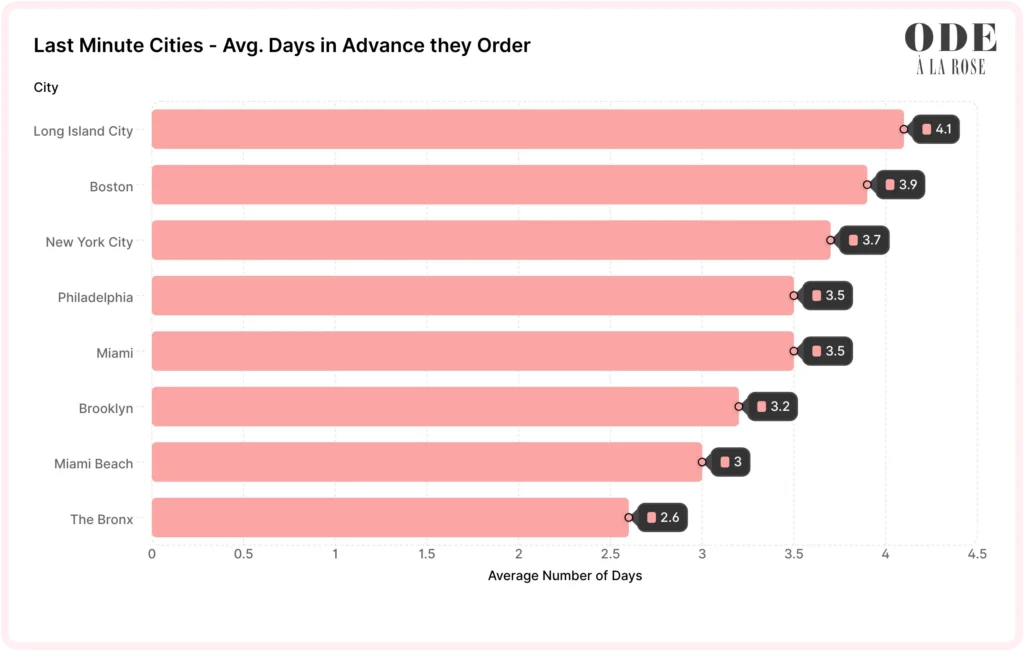
If the previous cities are the planners, these are the opposite. East Coast urban centers dominate this list, with average lead times under three days and significant percentages of same-day orders. The data suggests that in these cities, Valentine’s Day planning is compressed into the final 72 hours, with many people literally ordering flowers the morning of February 14th.
The Spontaneous Romantics: 3 Days or Less
Several East Coast cities embrace the last-minute life:
The Bronx, New York wins the spontaneity award at just 2.7 days in advance, with 17% ordering same-day. Another 39% order in the 1-2 day window, meaning over half of all Bronx orders are placed with 2 days or less of lead time. Only 12% order a week or more ahead.
Miami Beach, Florida (3.0 days) brings beach-town spontaneity to Valentine’s Day. With 16.7% same-day orders and 30% in the 1-2 day window, nearly half of Miami Beach orders come in the final 48 hours. Only 12% plan a week or more in advance. The tourism and hospitality economy probably plays a role – irregular work schedules don’t leave much room for advance planning.
Brooklyn, New York (3.2 days) absolutely leads the nation in same-day deliveries at 20.5%. Add another 27% ordering in the 1-2 day window, and nearly half of Brooklyn orders arrive within 48 hours. Only 16% plan a week or more ahead. Brooklyn’s creative class – media, arts, startups – apparently runs on tight deadlines for everything, including romance.
The Urban Last-Minute Belt: 3.5-4 Days
Major metros show consistently compressed timelines:
New York City (3.7 days) sees 17% same-day orders, with another 26% in the 1-2 day window. About 19% plan a week or more in advance. The city’s demanding work culture and abundance of delivery options may help enable procrastination as a lifestyle.
Miami (3.5 days) has 11% of orders placed same-day, with another 23% in the 1-2 day window. Only 17% plan a week or more ahead, marking a very stark difference from other Floridian cities that order well in advance.
Philadelphia (3.5 days) has a heavy concentration of orders in the 3-5 day window (74%), with 26% ordering in the 1-2 day range.
Long Island City (4.1 days) sits just above the 4-day mark, with 14% same-day orders and 18% in the 1-2 day window. About 24% plan a week or more ahead, showing a slight edge in planning over the other NYC-area neighborhoods.
Boston (3.9 days) cuts it close but not quite as close as their New York counterparts with 35% order in the 1-2 day window and about 25% plan a week or more in advance.
It appears that the availability of same-day options in these dense urban centers creates a culture where procrastination is not just possible, but normalized.
Regional Patterns & What They Might Mean
Looking beyond individual cities, we found several broader patterns that could tell us something about how different regions approach Valentine’s Day. From coast-to-coast differences to the surprising consistency within Texas, these patterns offer some hints on how geography and culture shape romantic planning.
West Coast vs. East Coast: The Planning Divide
West Coast cities consistently plan 1-2 days earlier than East Coast cities of similar size. Los Angeles (4.7 days) beats New York City (3.7 days) by a full day. Seattle (6.3 days) plans much further ahead than Boston (3.9 days).
Looking at the numbers, major West Coast cities average 5.5 days in advance, while East Coast cities average 3.9 days – a 1.6 day difference. Only 15% of West Coast orders come in the final 1-2 days, compared to 25% on the East Coast. Same-day orders? Just 5% out West versus 13% on the East Coast.
The reasons likely involve a mix of workplace culture, lifestyle pace, and regional attitudes toward planning and spontaneity.
Texas Does Its Own Thing
Both major Texas cities – Austin (5.2 days) and Houston (5.2 days) – show nearly identical advance planning. The consistency is remarkable: Austin has 9% ordering 13+ days out with 11% in the 1-2 day window, while Houston has 6% at 13+ days with 19% in the 1-2 day window.
Texas cities average 5.2 days – notably higher than the East Coast’s 3.9 days and even edging out the West Coast’s 5.5 days. Texas appears to have a “plan ahead” culture for romantic gestures, which is maybe a reflection of the state’s growing professional class.
Florida’s Split Personality
Unlike Texas’s consistency, Florida has cities on both extremes. Fort Lauderdale (6.1 days), West Palm Beach (5.0 days), and Key Biscayne (7.2 days) plan significantly further ahead, with 10-17% ordering two weeks early.
Meanwhile, Miami (3.5 days) & Miami Beach (3.0 days) show last-minute tendencies similar to other large East Coast metros, with 11-17% same-day orders and 23-29% ordering in the 1-2 day window. The overall Florida average of 4.4 days masks this internal divide.
Smaller Cities Plan Earlier
While not completely consistent across every city, we did find that on average smaller cities had longer planning horizons than major metropolitan areas. Cities with populations under 100,000 tended to order 1-2 days more in advance than cities with larger populations.
This could reflect differences in general delivery infrastructure and consumer expectations. While in recent years there are little differences in delivery available for most things, smaller markets may be used to having to order things in advance as opposed to having a plethora of last minute options right outside their doorstep.
The February Search Surge
In December, only 320 people nationwide searched for “valentines day flower delivery.” By January, that jumped to 22,000 searches – a 68-fold increase. February? 74,000 searches – more than tripling again.
Despite all this early research, most orders are placed within the last several days leading up to Valentine’s Day according to our order data.
This “search-to-action gap” is huge. People research options weeks in advance, but delay actual ordering until the last minute. Whether the reasoning for this is rigorous comparison shopping research or just plain old procrastination is up for debate.
Interest Spikes on Valentine’s Day
Despite all the regional differences in advance ordering, Google Trends reveals something universal: across all seven states we tracked (California, Florida, Illinois, New York, Ohio, Pennsylvania, Texas), search interest for “flower delivery” peaked at maximum (100) on February 14, 2025.
Even in ultra-prepared Seattle, search interest spikes on the day itself. Valentine’s Day creates last-minute panic everywhere, regardless of regional culture.
The national keyword data backs this up: “flower delivery” searches jumped from 368,000 in January to 823,000 in February – a 124% increase concentrated in the week before Valentine’s Day. “Valentines day flower delivery” went from 22,000 to 74,000 (236% increase), with most of that happening February 10-14.
While we can’t view this data hourly – it’s likely that a majority of these searches went unfulfilled as most florists will have limited inventory & delivery capacity if you wait until the literal last minute like so many people do.
The Day of the Week Matters
Valentine’s Day 2025 fell on a Friday. The day of the week can influence ordering patterns – when Valentine’s Day falls on a Monday or Tuesday, for example, some people may order earlier to ensure delivery before the weekend. When it falls on a Thursday or Friday, the entire week leading up remains available for delivery, which may affect timing decisions.
What This Actually Tells Us

Looking at all this data, a few bigger insights emerge:
Infrastructure creates permission to procrastinate. Cities with mature same-day delivery networks – New York, Brooklyn, Miami – show way more last-minute ordering. The presence of reliable last-minute options fundamentally changes consumer behavior, making procrastination a viable strategy rather than a risky gamble.
Work culture bleeds into personal life. The correlation between tech hubs (Seattle, Austin, San Francisco suburbs) and advance planning suggests systematic workplace cultures extend to romance. Meanwhile, cities dominated by finance and law (New York, Boston) show more last-minute tendencies – maybe because these industries reward crisis management and deadline performance.
The search-to-action gap is real. People search for Valentine’s options in January (22,000 searches) but don’t order until February (74,000 searches, concentrated in the final week). This mirrors the typical holiday shopping pattern: we browse early, weigh our options, and only commit to a purchase when the deadline makes it necessary. It’s this modern, fun-loving indecision that keeps the romance industry on its toes.
Regional stereotypes are complicated. West Coast “laid-back” culture produces earlier planning (maybe because relaxed schedules enable forethought), while East Coast “hustle culture” embraces last-minute execution. Texas cities defy Southern spontaneity stereotypes with systematic planning. Regional culture definitely shapes how people express romance – just not always in expected ways.
Valentine’s Day is still special. Despite decades of marketing and the ability to plan months ahead through e-commerce, Valentine’s Day remains a compressed-timeline event. The universal February 14 search spike confirms it: this holiday maintains its character as a high-stakes deadline that triggers last-minute behavior, regardless of how much advance awareness people have.
Why This Matters
If you’re ordering flowers: The data is clear – ordering in advance is always the best strategy. You’ll get your top pick of bouquets (favorites often sell out), guarantee you won’t forget, and cross one thing off your to-do list early. In cities with compressed timelines (under 3.5 days average), this is especially crucial as competition for popular arrangements intensifies closer to Valentine’s Day.
If you’re in retail: Same-day delivery infrastructure directly changes customer behavior. Investing in logistics capabilities will capture late-deciding customers. The search-action gap also shows a big opportunity: people searching in January should get February reminders to actually place those orders.
If you study relationships: Geographic variations in Valentine’s planning correlate with broader cultural patterns. Cities that plan romantic gestures earlier might show systematic differences in other planning domains too – retirement savings, vacation booking.
The Bottom Line
American Valentine’s Day flower ordering reveals a country split between planners and procrastinators, with clear patterns based on geography, culture, and economics. Seattle’s 6.3-day advance planning and Brooklyn’s 20% same-day rate represent opposite ends of a spectrum that says something deeper about how we approach romance, time management, and deadlines.
Despite regional differences, one thing is universal: Valentine’s Day maintains its power as a high-stakes romantic deadline. The jump from 320 December searches to 74,000 February searches for “valentines day flower delivery,” combined with search peaks on Valentine’s Day itself across all states, confirms this holiday is unique in how it compresses decision-making.
The orders we analyzed represent more than transactions – they capture the intersection of love, logistics, personality, and procrastination across American cities. Whether you’re ordering six days ahead in Seattle or same-day in Brooklyn, you’re marking Valentine’s Day with flowers. And that order reflects not just your romantic intentions, but something about where you live and how you live.
As delivery options continue to evolve, we may see consumer behavior shift. But if this data tells us anything, it’s that Valentine’s Day will always inspire both thoughtful preparation and last-minute panic – no matter how many weeks’ notice we get.
Data analyzed from Valentine’s Day 2025 orders, Google Trends from seven major states, and national keyword search volumes. Cities included based on statistical significance (sufficient order volume for data to not be skewed by a few outliers).